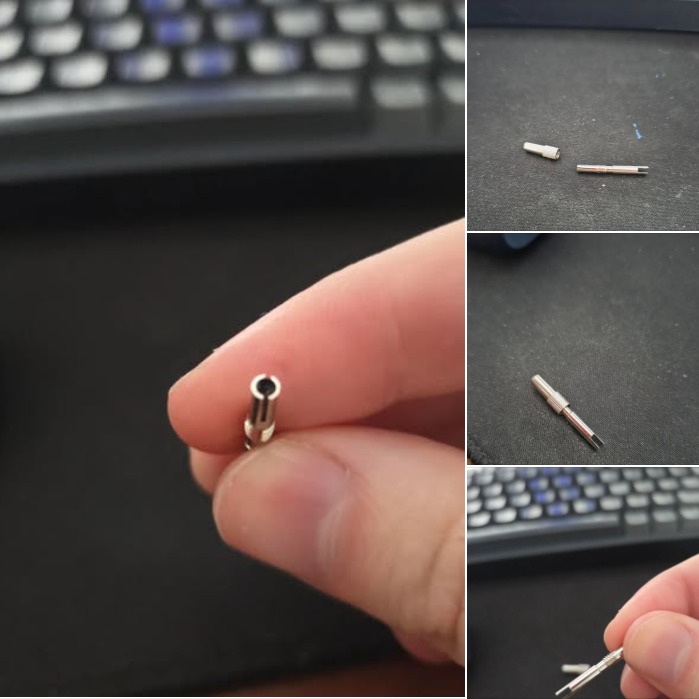
Finding a small, unfamiliar object tucked away in a drawer often triggers a brief moment of curiosity followed by dismissal, yet occasionally such discoveries open doors to unexpectedly rich memories. A tiny silver piece with two prongs or a narrow grip can appear meaningless at first glance, resembling scrap metal or a broken component from something long forgotten. But once recognized as a compass lead holder, it transforms instantly from a mystery into a symbol. For many adults, it awakens memories of school desks, pencil cases, and the faint smell of plastic geometry sets snapped open before math class. This object was never the star of the kit, never the one students proudly showed off, yet its absence was deeply felt. Without it, the compass became awkward, unbalanced, and nearly useless. The lead holder’s small size made it easy to lose, but its importance far outweighed its physical presence. In remembering it, people often remember more than just an object; they recall a time when learning required patience, fine motor control, and a respect for tools that demanded care rather than instant results.
Geometry sets once held a special place in education, representing a bridge between abstract concepts and physical action. Before digital tools and interactive screens, students learned through touch, repetition, and precision. The act of opening a hard plastic case, arranging each piece neatly, and ensuring nothing was missing was part of the learning ritual. The compass lead holder, often stored loosely or screwed delicately into place, was the most fragile part of that ritual. Its disappearance could derail an entire lesson, turning a simple task into frustration. Teachers knew the sound of a student asking for a spare, and classmates recognized the helpless feeling of holding a compass that could no longer draw. This small component taught an unspoken lesson: details matter. Accuracy depends not only on understanding concepts but on maintaining the tools that make those concepts visible. In a subtle way, the lead holder embodied responsibility, showing that neglecting even the smallest part could disrupt the whole system.
Functionally, the compass lead holder is a marvel of simplicity. Its job is straightforward: to grip a thin piece of graphite firmly and align it perfectly with the compass point so that circles can be drawn cleanly and evenly. Yet achieving this requires careful design. The holder must apply enough pressure to keep the lead stable without snapping it, while allowing easy adjustment as the lead wears down. Many versions include a miniature screw or spring mechanism, reflecting a level of mechanical thought rarely appreciated by the students who used them. Through repeated use, learners developed an intuitive sense of balance and control, adjusting pressure by hand rather than relying on automated correction. This tactile feedback trained coordination and patience, reinforcing that precision comes from deliberate action. In an age when many tools now correct errors automatically, the compass lead holder stands as a reminder of a time when mistakes were visible and improvement came through practice.
Beyond its practical role, the lead holder carries emotional weight for those who grew up using it. It evokes classrooms filled with quiet concentration, the scratch of graphite on paper, and the tension of trying to make a perfect circle under time pressure. Losing it often felt catastrophic, not because it was expensive, but because it symbolized failure to keep track of one’s responsibilities. Finding one years later can feel oddly comforting, like reconnecting with a younger version of oneself who struggled, learned, and improved through trial and error. These emotions highlight how everyday objects become anchors for memory. Unlike trophies or certificates, the lead holder was never meant to be sentimental, yet it absorbs meaning through use. It reminds people of structured learning environments, of rules and routines that shaped thinking, and of the satisfaction that came from mastering something tangible.
In modern classrooms, the role of such tools has diminished. Software can generate flawless circles instantly, and measurements can be adjusted with a click. While these advances bring efficiency, they also remove the slow, physical engagement that once defined learning geometry. The compass lead holder, now often found only in older kits or replacement parts catalogs, represents a different educational philosophy. It belongs to a time when understanding was built through doing, when hands-on effort reinforced mental concepts. Its continued availability, despite being largely obsolete, speaks to its enduring usefulness and thoughtful design. There are still students, artists, and hobbyists who prefer traditional instruments for their directness and honesty. For them, the lead holder is not outdated but reliable, offering a connection to foundational skills that digital tools cannot fully replicate.
Ultimately, the story of the compass lead holder is a story about how small things shape larger experiences. Its size made it easy to overlook, yet its function was essential. Its design was simple, yet it demanded care. Its presence was quiet, yet its absence was disruptive. In recognizing and naming it, people reconnect with a slower pace of learning and a deeper respect for the mechanics behind simple tasks. The object teaches that knowledge is often built from modest components working together, and that progress depends as much on attention to detail as on big ideas. Long after geometry sets have been packed away, the memory of that tiny metal piece lingers as proof that even the most unassuming tools can leave a lasting imprint on how we