A story that began as loss, tragedy, and sinking memories took a breathtaking turn two years later—when a diver retrieved a barnacle-covered camera from the bottom of the ocean and uncovered photographs its owner thought were gone forever.
The camera belonged to Vancouver artist Paul Burgoyne, who suffered a heartbreaking loss in 2012 when his boat, The Bootlegger, was shipwrecked during a 500-kilometer journey from Vancouver to his summer home in Tahsis, British Columbia. The vessel sank quickly, disappearing beneath the waves along with Paul’s belongings—including a camera filled with irreplaceable photos.
“That just shocked me,” Burgoyne said when he heard it had been recovered. “Getting the camera or the photos back… that’s really quite wonderful.”
Two years later, in May, students from the Bamfield Marine Sciences Centre—Tella Osler and Beau Doherty—along with Diving and Safety Officer Siobhan Gray, were conducting research dives off Aguilar Point when they discovered something unusual resting 12 meters below the surface. What looked like a strange, coral-encrusted lump turned out to be a digital camera, completely overtaken by marine life.
Marine Ecology professor Isabelle M. Côté explained that the camera had become a miniature ecosystem, layered with colorful organisms—a reminder of nature’s ability to thrive in unexpected places.
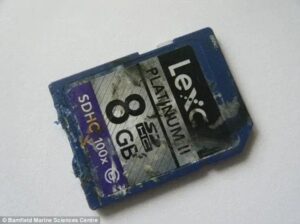
Inside the heavily damaged camera, however, one thing had survived: the Lexar Platinum II, 8 GB memory card, which was somehow still fully operational. When the team developed the photos, they found a family portrait. Côté posted it online in hopes of finding the owner.
Fortune finally intervened.
A member of the Bamfield coast guard recognized Burgoyne in the picture—having been the same officer who rescued him during the shipwreck. Soon after, arrangements began for a heartfelt reunion between Paul and his long-lost memories.
“I have a new respect for these electronics,” Burgoyne said with a laugh. “You throw most of this stuff away every few years, but that little card… it’s an amazing bit of technology.”
The photos transported him instantly back to the day the ship went down, the calm moments before chaos, and the final images taken just an hour before the wreck. Among them were deeply emotional snapshots: his family scattering his parents’ ashes at Lake of the Woods, and a video capturing the violent waves that eventually sealed the boat’s fate.
What began as a dive became a miracle of memory—proof that the sea gives back in its own time.
When Paul finally sat down at the marine station to review the recovered photos, he braced himself for a wave of emotion. And it came—slowly, like a rising tide. But as he clicked through the images one by one, something else crept in… something strange.
Something unsettling.
There were photos he remembered taking—shots of the storm clouds, the swirling water, the deck of the boat as he fought to stabilize it. But then… there were photos he didn’t remember at all.
Blurry shapes.
A silhouette at the edge of the boat.
And then—one picture that made his blood run cold.
A face.
Pressed against the cabin window.
Pale. Distorted. Eyes wide.
Watching him.
Paul leaned closer, his breath tightening. The divers behind him exchanged looks, unsure whether the image was some kind of trick of the light or something else entirely.
“That… wasn’t me,” Paul whispered.
Professor Côté frowned. “Are you sure? Sometimes in panic, our memories—”
“No,” Paul cut in. “I know what I look like. That’s not me. And I was alone on that boat.”
The room fell silent.
The Divers Speak Up
Beau, one of the student divers who had found the camera, cleared his throat.
“Sir… there’s something you should know.”
Paul turned slowly.
“We didn’t find the camera inside anything,” Beau said. “We found it sitting on the sand. But… it looked like it had been placed there. Upright. Not fallen.”
“Placed?” Paul repeated.
Tella nodded. “There were drag marks in the sediment. Like something picked it up… moved it… and set it down.”
A chill crept up Paul’s spine.
“Maybe another diver?” he asked.
But Siobhan, the experienced safety officer, shook her head firmly.
“No diver has any reason to be in that area,” she said. “It’s dangerous, unpredictable, and there are no recreational routes there. Besides… the marks weren’t made by fins.”
The room grew heavier—quiet except for the hum of the overhead lights.
The Last Photos Reveal a Pattern
Paul clicked further through the images as the divers looked on. The final ten photos were all taken in rapid succession—seconds apart.
And each showed something closer… and closer… approaching the camera.
The outline from the window appeared again, this time clearer. A face, yes—but not fully human. The water had blurred the details, or distorted them, but the expression…
The expression was unmistakably desperate.
“Is this some kind of sick joke?” Paul asked, though he already knew the divers were telling the truth.
“No joke,” Beau murmured.
Professor Côté exhaled slowly. “There have been stories,” she finally said. “Among local fishermen. About that area. Whispers of shadows in the water after storms. Figures seen on the waves. Survivors of old wrecks who never quite made it home.”
Paul scoffed softly—but he couldn’t shake the growing unease twisting inside him.
Paul Returns to the Wreck Site
A week later, Paul made a decision no one expected: he would return to Aguilar Point.
“I need to see it myself,” he insisted. “I need to understand.”
The divers agreed, reluctantly, to accompany him. The sea was calm as the boat approached the area where The Bootlegger had disappeared. The water looked almost peaceful—nothing like the violence of the storm that night.
But as Paul peered over the edge, something pulled at him. A memory. A sensation. A whisper of fear.
The divers entered the water first. Paul remained on the boat, watching their descent through the rippling surface. Minutes passed.
Then—
A splash behind him.
Paul spun around.
Floating on the swell was a small plastic object… coated in ocean slime.
A memory card.
Just like the first.
But this one was cracked.
Paul lifted it with trembling fingers.
“This wasn’t here before,” Siobhan called up from the water. “We didn’t drop anything.”
Paul stared at the ocean—at the dark shape beneath the water that now moved, slowly, deliberately, almost circling the boat.
Something was down there.
And it had been waiting.
The Final Revelation
Back at the marine station, the cracked memory card was carefully cleaned and inserted into a reader. At first, the files appeared corrupted—just static, lines, and broken fragments.
Until one image loaded fully.
A perfectly clear shot of The Bootlegger.
Taken from the water.
At night.
Paul’s breath caught.
He remembered that moment vividly—the storm, the chaos, the boat turning sideways. But he had never seen his vessel from that angle.
Someone—or something—had taken this picture.
Behind him in the image, half-submerged, was the same pale face from the earlier photographs.
Not distorted this time.
Not blurred.
Human.
Clearly human.
A woman.
Her hair floated around her like dark seaweed. Her eyes wide and pleading. Her hand stretched toward the boat.
Paul stepped back from the screen, shaking, his mind racing.
He knew that face.
It was a woman who had gone missing in those waters a decade before his accident. A story he’d heard in passing, a name he hadn’t remembered until now.
She hadn’t survived the storm.
But she had been there that night.
Watching him.
Trying to reach him.
Trying to be seen.
A Memory Returned, A Message Understood
The ocean had not returned the camera by accident.
It had returned a witness.
A warning.
And a plea not to forget the lives the sea had taken.
Paul now keeps both memory cards in a sealed case, not as relics of fear—but as powerful reminders of the thin line between the living and the lost… and the secrets the ocean carries in its depths.
Some memories drown.
Some resurface.
And some refuse to stay buried forever.